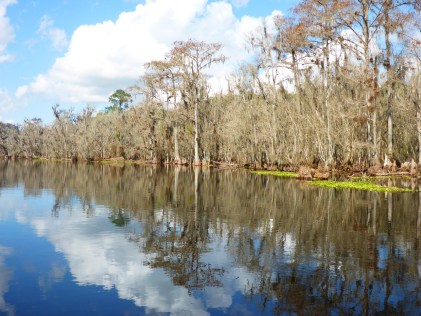
 I had started to wonder if Cannon Springs and the Okhlawaha River was going to be my holy grail. Starting in September and lasting until March 2016, the Rodman reservoir on the Okhlawaha River is drawn down, the river-lake levels lowered substantially. This draw down occurs every few years—to prevent fish kills and reduce the vegetation that obstructs the water—and exposes the natural flow of the river. The lowered levels on the Okhlawaha River offer us a glimpse of the past and a future that could be—without the Rodman Dam. I was especially interested in seeing those springs like Cannon that reveal themselves only during these periodic drawdowns.
My first attempts to get on the river resulted in a series of major errors—locking the keys in the car at the remote Kenwood boat ramp, battery-less GPS and camera, and less than complete information about boat ramps. (I am now my own case study in fieldwork errors for my Religion and Fieldwork class.) As more and more spectacular pictures adorned my facebook feed, I was even more determined to see—and swim in—Cannon springs.
Finally, I made it—twice in one week. Armed with the GPS coordinates, my husband Kevin and I found the elusive put-in across from Payne’s Landing. We turned down a sandy road, lined with ‘NO ATV’ signs, and bumped our way through the small Hog Valley community towards the river. We launched and pointed our boats upstream. The entrance to the Cannon Springs Run was approximately one mile south of Payne’s Landing, and the entrance had been described as ‘unmistakable’, a tree-lined clear passage. I was also hoping to find Tobacco Springs situated between Payne’s Landing and Cannon Springs.
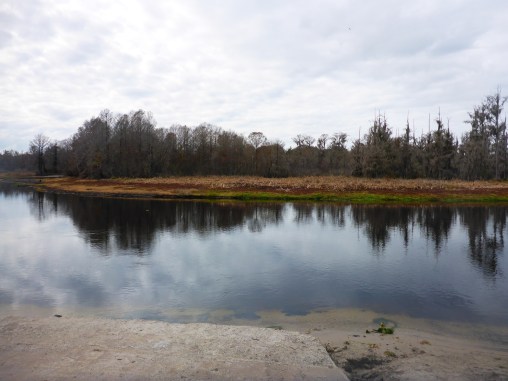
The river at Payne’s Landing is broad with an expansive vista. Several fisherman sat on the east side of the river, where the draw down has exposed the beach. The day was overcast, but warm, a seemingly auspicious start to our journey. Some parts of the shore had healthy trees that have survived the flooding, while other patches revealed the desolation of a dying landscape.
Heading south, we heard shots which continued for about 15 minutes—target practice, we assumed, so we paddled on, but a bit unnerved. Soon after, the batteries in both the GPS and the camera failed. Three inauspicious signs, but we kept going. We settled into a rhythm against the slight downstream flow and saw woodstorks, ibis, egrets, and a variety of herons—and of, course, gators.


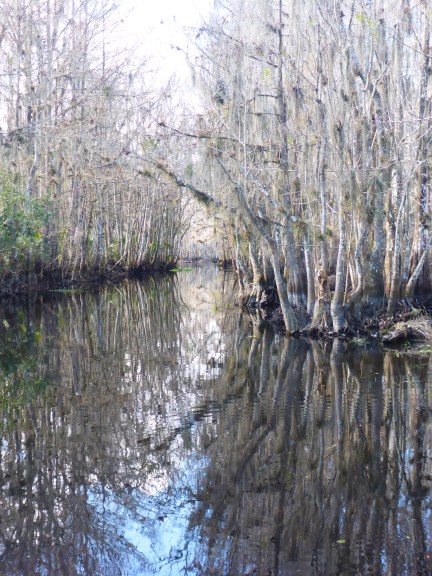
We paddled mostly in the center of the river, avoiding the vegetation near the banks where gators like to hide. Kevin paddled into the vegetation once and heard the unmistakable splash of a startled gator. After about half a mile, the wide river narrowed into a series of s-curves, and dark lines on the trees along the bank told us what has become the new normal for water levels— the flood stage caused by Rodman/Kirpatrick dam.  Finally, we spotted what had to be the entrance to Cannon Springs. Everyone said that the entrance to the Cannon Spring Run is unmistakable—a tree-lined corridor, and they were right.
The water cleared quickly as we paddled up the short spring run. First we saw several vents that are part of the larger Cannon Spring system, then the blue spring itself. The spring is relatively shallow so the vent is visible. I pulled out my mask and snorkel and dove into the clear water to see the vent. (Swimming in January is a major benefit of living in Florida.)


Seeing Cannon Springs once was not enough, so when I saw the Aquaholics trip down the Okhlawaha River scheduled for the following Saturday, I immediately signed up. I met the group at 9 am at Eureka West boat ramp, and after shuttling cars to Payne’s Landing, we floated downstream. Karen Chadwick, boat captain for North Star Charters, joined us in her kayak for the float and offered both historical and environmental perspectives on the river and its ecoheritage. She is also Vice President of the Putnam County Environmental Council and member of Florida Defenders of the Environment has been working to restore the Okhlawaha River to its free-flowing state, carrying on Marjorie Harris Carr’s environmental legacy. As we floated downstream, Karen pointed out historical features that I would have otherwise missed and also led us to the elusive Tobacco Springs.
We saw a number of milled logs, remnants of the days of logging the surrounding forests. She also pointed out the wooden remnants of a steamboat launch area. When steamboats travelled the river, there were launches almost every mile, dropping off and picking up lumber and other supplies. The St. Johns and the Okhlawaha were once Florida’s highways, making travel possible before roads penetrated the swamps and forests. Just a few wooden remnants are visible now. 
Then, finally, Tobacco Springs! Kevin and I had looked for it, but never found it. Not surprising – the spring run was clogged with water lettuce. Our group of intrepid kayakers (and my paddle-board) pushed our way through the vegetation until fallen trees blocked our path. We dragged our boats onto the bank and walked a several hundred feet through fairly dry muck. The spring was worth it – deep and not as clear as Cannon Springs, but full of fish. We peered down into the spring from the ruins of an old dock. None of us dared swim here, given the possibility of alligators in the cave below.


Just beyond Tobacco spring, we explored the ruins of the Strange house on land that is now part of the Florida Greenway. Dr. Strange built a house on the Okhlawaha River, complete with pool, patio, and river-front view. The family lost access to the land during construction of the never-completed Cross-Florida Barge canal. Tragically, Dr. Strange and his grandson were killed when their truck rolled into the river.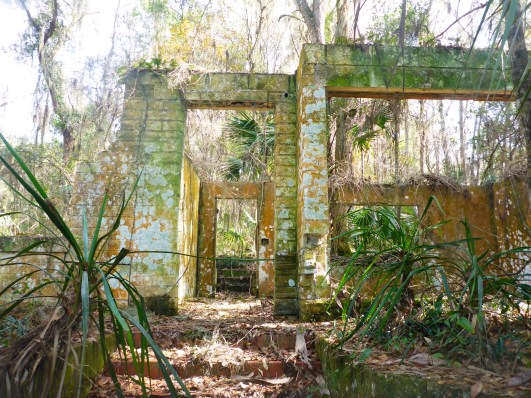
I found my grail – Cannon Springs and Tobacco Springs, gifts from the current drawdown. I hope to get back out again soon. Karen said that the river has already risen, and starting on March 1, 2016, the reservoir will continue to fill, rendering these springs almost imperceptible. The exposed beaches will be submerged again, drowning nesting areas for birds and turtles. I’d like to paddle this section of the Okhlawaha River again, just to see what it is like when the water floods again, but I have a feeling that I will be disappointed. 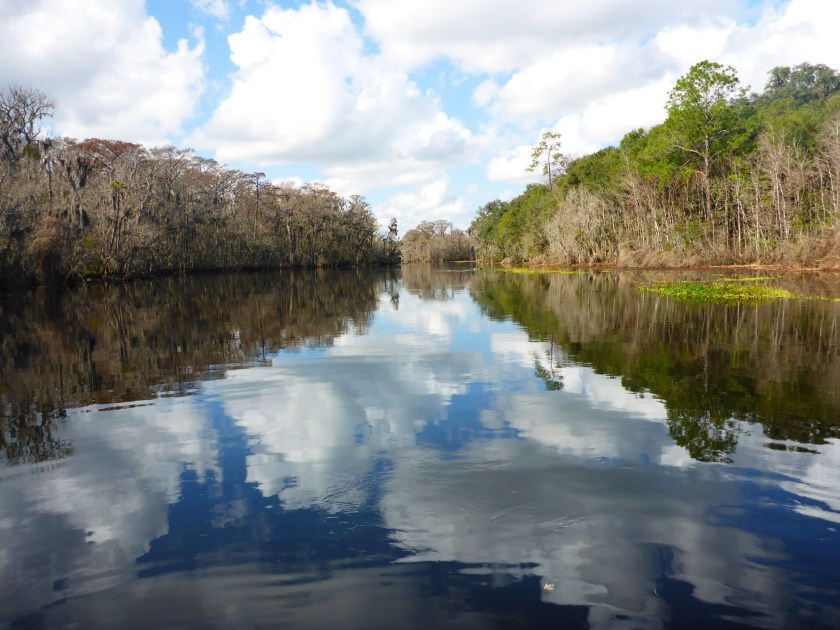

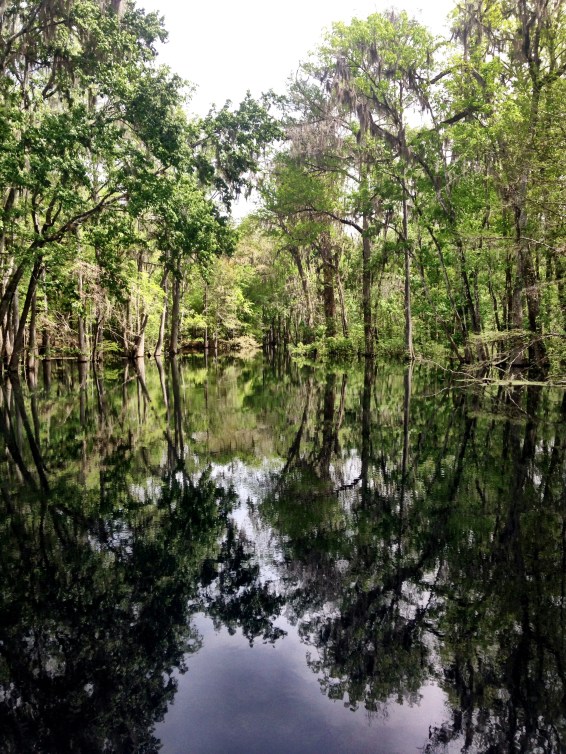
 Florida Waterscapes